
staying foolish since 1987.
Ever since I can remember, I have been the child pictured above—curious to the point of obsession, endlessly drawn toward meaning, language, systems, and form.

Creation, for me, has never been a profession alone, but a way of navigating and interpreting the world.
My path through design has been anything but linear. For years, I moved between disciplines, ideas, and experiments with an intensity I only later came to understand more clearly through the lens of ADHD. In retrospect, design became both structure and language: a way to organize complexity, translate intuition, and give shape to thoughts that often existed long before words.
I still recognize myself in that five-year-old girl sitting on the floor surrounded by books, dictionaries, and loose sheets of paper—reading, translating, annotating, searching for hidden meanings and connections with endless fascination. Graphic design eventually became an extension of that same impulse: another language through which to observe, interpret, and communicate.
I am equally inspired by tradition and modern minimalism—two seemingly opposing forces that, to me, are deeply interconnected. Much of my work exists somewhere between the two: balancing emotional resonance with structural clarity, symbolic depth with contemporary precision.
Over the years, this perspective naturally led me toward projects rooted in wellness, science, and biotechnology—fields driven by transformation, systems thinking, and the desire to contribute something meaningful to the wider fabric of life.
“You should be angry. You must not be bitter. Bitterness is like cancer. It eats upon the host. It doesn’t do anything to the object of its displeasure. So use that anger. You write it. You paint it. You dance it. You march it. You vote it. You do everything about it. You talk it. Never stop talking it.”
A Personal Constellation of Influences

Hugo Alvar Aalto
Aalto’s unique non-denominational approach to design as a whole and the refusal to ever call himself an artist per se have hit so very close to home since I was just a kid. Perhaps it was the long hours spent on the lap of a Soviet-era architect—my grandfather—or the serenity of the Scandinavian esthetics that contributed to this peculiar sense of kinship with Aalto’s intuitive yet pragmatic style.
Even though I don’t necessarily “look at” Aalto on a regular basis these days, his philosophy and taste seems to have permeated virtually every aspect of my life—in the form of Finnish interior elements across the living space, cherished buildings, and my professional approach. “Building art is a synthesis of life in materialized form. We should try to bring in under the same hat not a splintered way of thinking, but all in harmony together.” Aalto is undoubtedly the inspiration behind my deep appreciation for inclusive design as “comprehensive artwork” (Gesamtkunstwerk) and each of my favorite contemporary designers, including Mario Hasuike, Maria Benktzon, Bjørn Friborg (and Helle Mardahl), and many more.
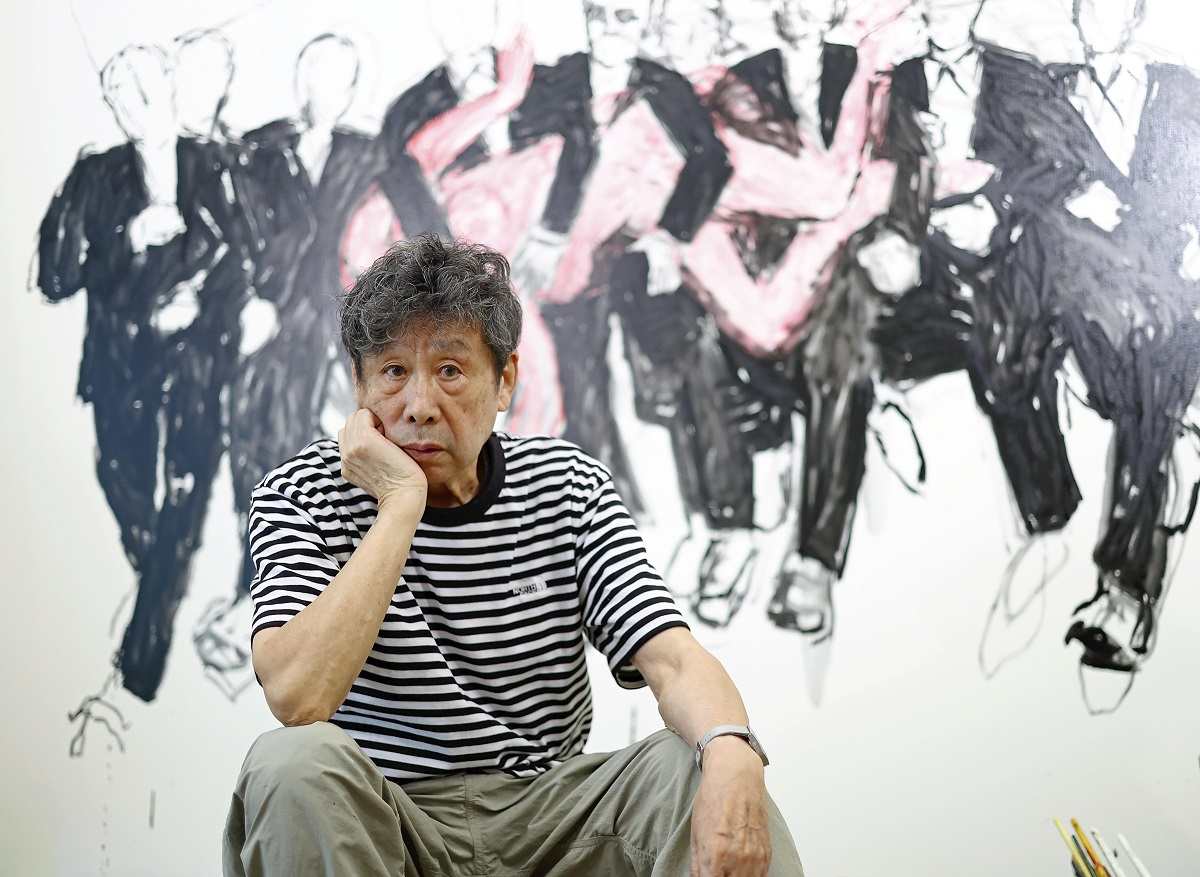
TADANORI YOKOO
It is perhaps this customary pursuit of panoptic harmony that has drawn me towards both contemporary and traditional Japanese aesthetics. While I admire and follow dozens of brilliant Japanese illustrators and artists to this day, Tadanori Yokoo is by far my absolute favorite. What I find so very fascinating about him is the ability to juxtapose a range of elements and formats in a way that only contributes to the customarily well-balanced traditional Japanese visual style.
Bold, versatile, and never repetitive, the signature Yokoo “system” is easy to identify, but impossible to predispose, tinging its way through familiar arrangements à la Lautrec, Isle of Wight, Woodstock and Kitagawa Utamaro—all at the same time. While I personally prefer cleaner, significantly more unsullied yet less rebellious visual systems in everyday work, to be able to create something as impossible to define or categorize is truly exhilarating and unfettering for any budding designer.

IRMA BOOM
As a book worm and literary translator, I am partial to Irma Boom as the indubitably finest Book Architect of our time. I was only 5-6 when I started sewing books and notebooks with discarded fabrics and yarn, looking for exciting new ways to store pressed flowers and favorite book excerpts.
To this day, restyling and repurposing stationery is one of my favorite pastimes—perhaps because of the sense of kinship I have always felt with paper and calligraphy. To be able to find unprecedented form as a metaphor for hundreds of thousands of words—with such unique sensitivity to detail and commitment to ubiquitous order and relatability that characterizes Boom’s work—is certainly an actual superpower. And since every great book is a dimension of its own, it would be an absolute honor to recreate just about anything some day.
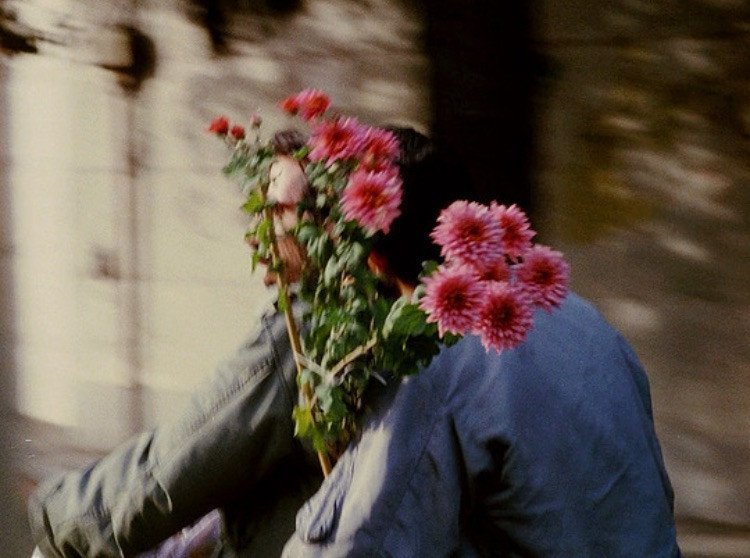
ABBAS KIAROSTAMI
Kiarostami is by far my favorite filmmaker, photographer, and poet, to say the least. I learned about him quite early on, as my grandparents had resided for several years in Tehran, prior to returning to Tbilisi in the late 1970s. The iconic pink asters from Close Up and the curvy road through the brindle hills of The Taste of Cherry, engraved so vividly in my memory for decades, carry with them the original scent and temperature, the sentiments, quasi-philosophical dialogues, and the balmy sounds that are impossible to mimic or think out.
With the advent of internet and, most importantly, Spotify, my love for Kiarostami has only grown deeper: appreciation of cinematographic esthetics has gradually evolved into an interdisciplinary sensitivity of sorts. With the sundry sound palette that features both Soon Over Babaluma and Mulatu Astatke, pre-revolution Irani psychedelic rock and Claudette et Ti Pierre, It would be safe to say that Kiarostami’s films have also shaped my musical taste significantly.